Choosing the wrong hose for chemical transfer costs more than money. It can cost lives. A hose that degrades under chemical exposure does not just leak. It fails at the worst possible moment, often when pressure is highest, and the substance being transferred inside is most dangerous. That is a risk no plant manager should accept. So what makes stainless steel hoses the right choice for chemical transfer? Let’s break it down.
The Problem With Standard Hoses in Chemical Environments
Not every hose is built to handle aggressive chemicals. Stainless steel hoses, especially those built to 316L grade, sit at a different level when it comes to chemical compatibility and structural durability.
Rubber hoses can swell, crack, or break down when exposed to solvents, acids, or alkalis over time. The degradation is not always visible from the outside, which makes it worse. You may think the hose is fine right up until it is not. That uncertainty alone should push you toward a material grade that actually holds up under consistent chemical exposure.
PTFE-lined hoses offer better chemical resistance, but they come with their own limitations around flexibility and pressure ratings in certain setups
Why 316L Grade Matters
Not all stainless steel is the same. Grade 304 works well in general applications, but it has a known weakness with chloride exposure. If your transfer process involves chlorinated solvents, hydrochloric acid, or seawater-based solutions, then 304 will pit and corrode over time.
Grade 316L contains molybdenum, which gives it better resistance to chlorides and acids. According to the British Stainless Steel Association, 316L is widely used in chemical processing, pharmaceutical manufacturing, and marine environments because of this property. The “L” designation means lower carbon content, which reduces the risk of sensitisation when fittings are welded to process pipework. Most buyers overlook this detail, but it matters when inspectors check welded joints under pressure.
If you are specifying hoses for chemical transfer, 316L should be the starting point, not an upgrade option.
Corrugated vs Smooth Bore: Which One Do You Need?
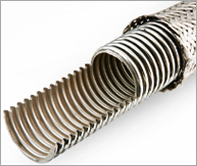
This question comes up often, perhaps more than people expect. Corrugated stainless steel hoses offer flexibility, making them easier to route around equipment and absorb vibration from pumps or compressors. Smooth-bore hoses give you better flow characteristics and are easier to clean, which matters in food-grade or pharmaceutical chemical applications.
The choice depends on what you are transferring and how the system is designed. For aggressive acids or slurries, a smooth bore with a stainless steel liner is often the safer call. For steam-assisted chemical lines or flexible connections between rigid pipework sections, corrugated hoses with stainless steel outer braid tend to perform well.
Pressure and Temperature Ratings
The Pressure Equipment Directive (PED) 2014/68/EU outlines the requirements for pressure equipment in the European industrial environment, including hose assemblies in chemical transfer operations. If you are subject to this directive, your hose supplier should be able to provide documentation of compliance. Do not accept oral statements on this point. Ask to see the test certificates and the working pressure at the actual operating temperature, not the ambient.
Couplings and End Fittings
When you pair a stainless steel hose with substandard couplings, the assembly is only as good as its weakest point. The tri-clamp coupling is also common in pharmaceutical and food chemical applications due to the ease of disassembly and cleaning. The camlock coupling is used in bulk chemical transfer operations.
What Failure Actually Looks Like
Chemical hose failure is not usually announced with any great fanfare. It tends to start with a slow weep at a fitting, a slight discoloration on the braid, or a faint chemical smell near the line. By the time the problem is obvious, the hose assembly may already be past safe use.
Most plant maintenance teams inspect hoses visually and do not always check the condition of internal bores or fittings. A hose can appear to be in good condition from the outside but have internal corrosion that does not become apparent until it is pressurised. This is when failure occurs, and it is not trivial.
Schedules for inspecting hoses, based on the manufacturer’s recommended service intervals, can prevent these signs from developing. The Health and Safety Executive in the UK recommends documented inspection programmes for hoses carrying hazardous substances, with records kept for each hose assembly in service. Quarterly visual checks are a reasonable baseline for most chemical transfer lines.
Read also: Why a Building Survey in Southampton Is Essential for Homebuyers
Sourcing the Right Specification
When you specify a stainless steel hose for chemical transfer, the supplier needs more than just the size. They need the chemical name or composition, operating pressure, temperature range, flow rate, and whether the line will see steam cleaning or aggressive CIP (clean-in-place) cycles.
A supplier who asks these questions is worth working with. A supplier who quotes on diameter and length alone will cost you far more in replacements and lost production time than the initial saving was ever worth.