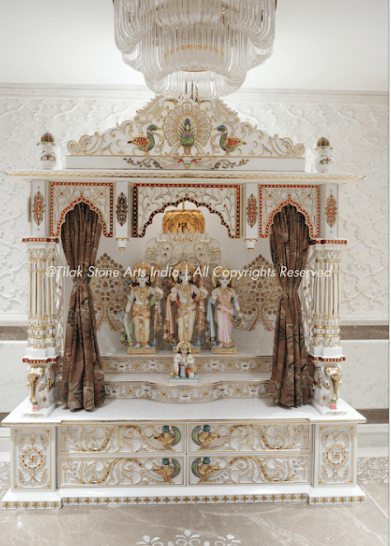
Everyone sees the end product. The spotless white marble temple resting within a set-aside area, glowing in warm light, appearing exactly as expected. What no one thinks about is all the process that goes into making the dream come true. This gap between imagination and reality is where most disappointment lies.
If you are planning to install a white marble temple in your home, understanding the design process before you start will save you a lot of frustration. Perhaps more importantly, it will help you ask the right questions before you commit to anything.
It Starts With the Space, Not the Temple
This surprises people sometimes. The first real design conversation is not about the temple itself. It is about where it goes and what surrounds it.
The northeast corner remains the most recommended placement for a home temple according to Vastu Shastra, the traditional Indian system of spatial arrangement. The reasoning involves directional energy flow, and most classical texts on the subject agree on this orientation. If your home layout allows for it, northeast is where you begin.
Once placement is confirmed, the designer looks at ceiling height, natural light, wall depth, and the overall proportions of the room. A white marble temple that looks perfectly sized in a showroom can feel overwhelmed in a large room or overcrowded in a small one. Scale matters enormously here, and it is something you cannot fully judge from a catalogue image or a 2D drawing.
Making The Stone Decision
This is where many purchasers fall into the trap of making wrong assumptions that come back to bite them in the end. It should be understood that all white marbles do not have the same characteristics, with grade, source, uniformity of grains, and finish affecting the marble’s appearance in the long run.
The Vietnam White Marble, for example, has emerged as the preferred material among serious temple architects. It goes by a few names: Swiss White Marble, White Vietnam Marble, Super Fine White Vietnam Marble. The grade varies, but the stone shares certain properties that make it well-suited for a home temple.
What Actually Gets Designed
Once the space and material are confirmed, the design work begins in earnest. This is more involved than most people expect.
Arch design comes first. Proportions of temple arch designs are governed by specific proportioning guidelines taken from temple architecture. An experienced mandir architect who is proficient in both classic guidelines and modern sensibilities will adhere to those proportions while accounting for the size of your space.
The jali pattern, the open lattice work that often appears on the sides or back panel of a home temple, needs to be designed relative to the overall size of the structure. A pattern that works beautifully on a large temple looks busy and cramped on a smaller one. This is the kind of thing that is easy to miss if you are working from a fixed template rather than a custom design.
The base is perhaps the most underestimated element. A heavy, well-proportioned base grounds the temple visually. Get it wrong, and the entire structure looks like it is sitting awkwardly rather than standing with intention.
The Part That Takes Longer Than You Think
Hand carving takes time. This is not something most buyers factor in when they start planning.
If your design includes detailed jali work or carved motifs in Super Fine White Vietnam Marble, the carving alone can take several weeks, depending on complexity. Rushing this stage is how you end up with edges that are not quite sharp, patterns that lose their definition, or proportions that drift slightly from what was agreed.
The manufacturers and designers who do this well are usually also the ones who will tell you honestly how long it takes. If someone promises a fully carved white marble temple in two weeks, that is worth questioning.
What About Installation
Delivery and installation of a marble temple at home involves more than carrying pieces through the front door. The weight of Vietnam White Marble means the floor needs to be assessed for load-bearing capacity, particularly in apartments. The pieces need to be assembled in sequence, and the jointing needs to be done correctly so the structure sits level and stable.
Designers who have overseen installations across different home types, including apartments in high-rise buildings, understand these variables. Those who only manufacture and hand over at the gate often do not.
See also: What a PCD Pharma Franchise Actually Needs From Its Parent Company
What This Tells You About Who to Work With
The design process for a white marble temple at home is longer, more involved, and more material-specific than it appears from the outside. That is not a reason to feel daunted. It is a reason to choose carefully who guides you through it.
Ask about the design process before you ask about price. The answer will tell you most of what you need to know.